
Anthrax is endemic in Saskatchewan, Alberta, and Manitoba. Practitioners may have or will encounter situations where anthrax is suspected. Recently several cases received by Prairie Diagnostic Services (PDS) have been packaged incorrectly, potentially putting PDS employees that receive these samples at risk. Please review the shipping and packaging instruction for anthrax suspected cases below.
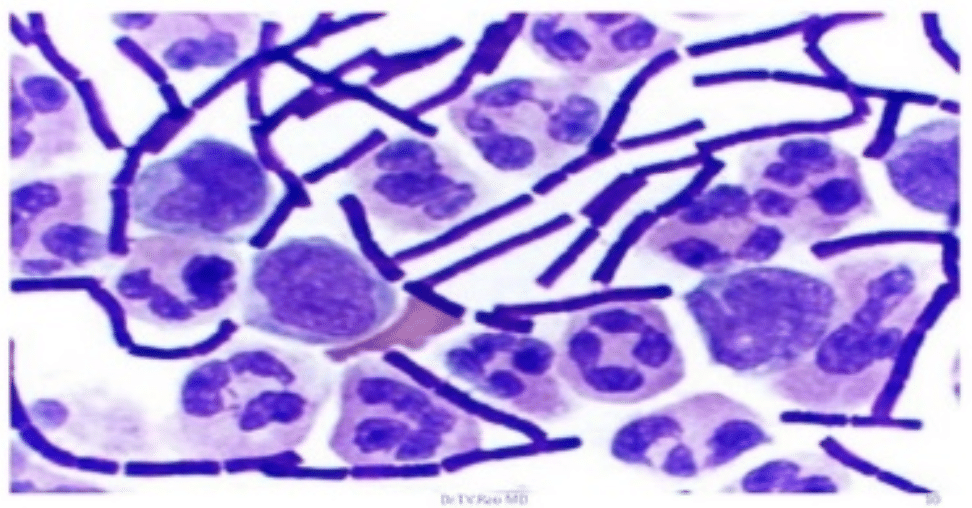
Case Definition: Any positive test kit result will be treated as a positive sample. If a test kit is negative, but the Disease Control Lab’s test indicates anthrax positive, the case will be determined to be positive. Bacillus anthracis PCR test will be done on Anthrax samples sent to PDS. Samples will be determined to be positive when the Bacillus anthracis PCR test is reported as Positive.
Sample Collection
It is important to collect specimens as soon as possible after death of the animal. ***If anthrax is highly suspected – DO NOT OPEN THE CARCASS***
Sample types listed in order of preference.
- Whole blood taken by syringe and needle from the jugular or tail vein and placed in a sterile vial. This remains the first choice and the best sample to submit to the lab. The blood-filled syringe can be submitted, providing that it can be sealed and is then placed in a sealed bag to avoid leakage; however, the needle MUST be removed first.
- Blood-soaked swab taken carefully through a small incision into the jugular. Cover the opening to capture any leakage. Place swab in a sterile tube, adding a few drops of saline to keep it moistened.
- Swabs taken from blood-tinged fluids exuding from anus, vulva, nostrils, or mouth. Place swab in a sterile tube, adding a few drops of saline to keep it moistened.
- As a last resort, submit a swab soaked with fluid from the spleen if the animal has been eaten by predators or if a necropsy was performed. Alternatively, swabs may be taken from turbinate bones of livestock and wildlife that have been dead for an extended period of time. Place swab in a sterile tube, adding a few drops of saline to keep it moistened.
- The submission of solid tissues from organs is discouraged, unless no other sample is available. DO NOT SUBMIT ears, tongue, or hide. AVOID CONTAMINATING THE OUTSIDE OF CONTAINERS CONTAINING THE SPECIMEN.
Packaging
- Provide a complete history for each animal. Fill out one separate test requisition form for each animal submitted. Please include the following information on the form when submitting samples:
- Name of submitting veterinary clinic/veterinarian;
- Owner’s name, phone number and address;
- ***Land location and RM number where the suspect animal(s) is (are) located***
- Species and number of animals on the premises;
- Number of dead animals;
- Date of first death; and
- Vaccination status for anthrax.
- Ensure RGS3 (Risk Group 3) is checked off on the submission form. Indicate “Anthrax suspect” in the history section of the submission form.
- Place a copy of the submission form in an envelope and attach it to the outside of the shipping container.
- Label each specimen as to origin (jugular blood, environmental swab, etc.). Please use rigid plastic containers with leak-proof lids for all samples.
- Place primary sample container (swab in transport media; blood in vacuum blood collection tube) inside a secondary leak-proof container such as a zipper-lock bag with sufficient absorbent material to absorb any liquid contents in the event of a spill or breakage.
- Coolant packs should also be placed inside this secondary container. Place paperwork inside separate zipper-lock bag on top of secondary packaging. When possible, place all items above within an inner box or pouch and label inner package “Anthrax suspect specimens.” Do not write this on the outer box. Place this inner package inside a rigid outer cardboard box.
- Refrigerate sample if there are delays in shipping to the lab; otherwise, ship all samples on ice packs.
- Dispose of used equipment and supplies separately – do not include them in the sample submitted.
Shipping
Submit samples to Prairie Diagnostic Services in Saskatoon. Advance notice of these shipments to PDS (306) 966-7316 will assist the laboratory in planning for receiving and testing the sample.
PCR testing can be performed STAT if received by 10 A.M. Any samples received after 10 A.M. will be processed the next business day.
In Saskatchewan, please see the following link for more details.
Anthrax-Information-for-Veterinary-Practitioners-2013.pdf (svma.sk.ca)